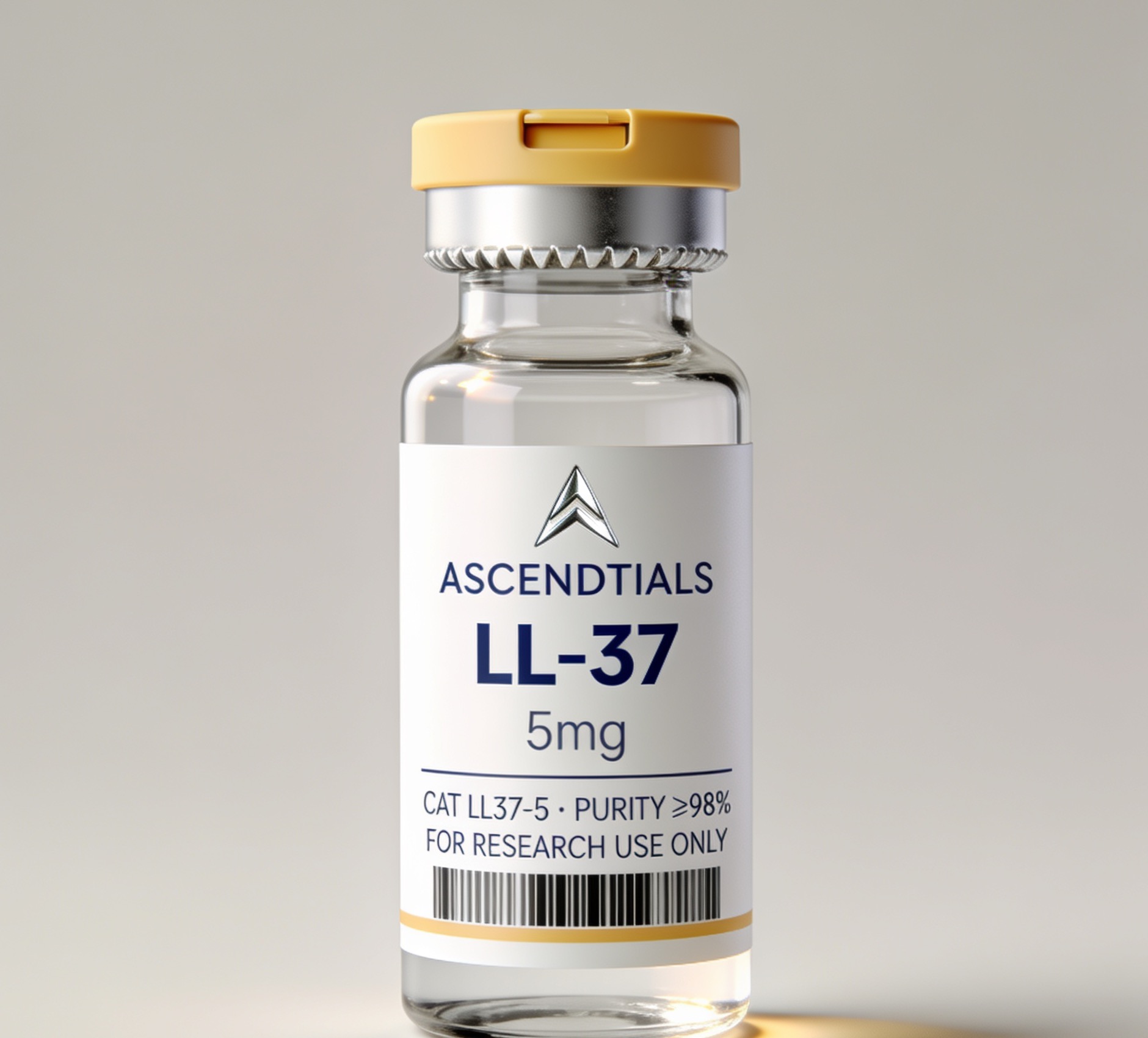
- Purity (HPLC)
- ≥ 98.4%
- CAS
- 154947-66-7
- Current lot
- LL3-2501B
LL-37 is a 37-residue cationic, amphipathic peptide released from the human cathelicidin precursor hCAP-18 (CAMP gene) when proteinase 3 cleaves it outside the cell. The name comes from its two N-terminal leucines and its length. It contains no cysteine.
In membrane-mimetic environments LL-37 adopts an α-helical structure, and NMR studies of the peptide and its shortest active fragment, KR-12, in lipid micelles define its membrane-binding surface. It interacts with and permeabilizes bacterial membranes in vitro, which is why it is classed as an antimicrobial peptide. It also acts as a ligand of formyl peptide receptor-like 1 (FPRL1), driving chemotaxis of neutrophils, monocytes and T cells in migration assays.
LL-37 is cited in host-defence peptide research, membrane biophysics, innate immune signalling and structure–activity studies of antimicrobial peptides. Its strong positive charge makes it stick to glass and plastic, and it aggregates after repeated freeze–thaw, so low-binding consumables are recommended.
Research use only. This material is sold for in-vitro laboratory research and development purposes exclusively. It is not a drug, food, or dietary supplement, has not been evaluated by the FDA, and must not be used in humans or animals.